
Bioavailability describes how much of an active ingredient—a drug, vitamin or skincare compound—actually reaches the bloodstream or its target in the body in a form it can use, and how quickly it gets there. It is a cornerstone concept in pharmacology and, increasingly, in aesthetics, because an ingredient is only as effective as the fraction that is genuinely absorbed. A product can contain a powerful active and still do very little if only a small amount of it is bioavailable.
At a glance
- Definition: The rate and fraction of an active ingredient that reaches the systemic circulation (or its target) in active form
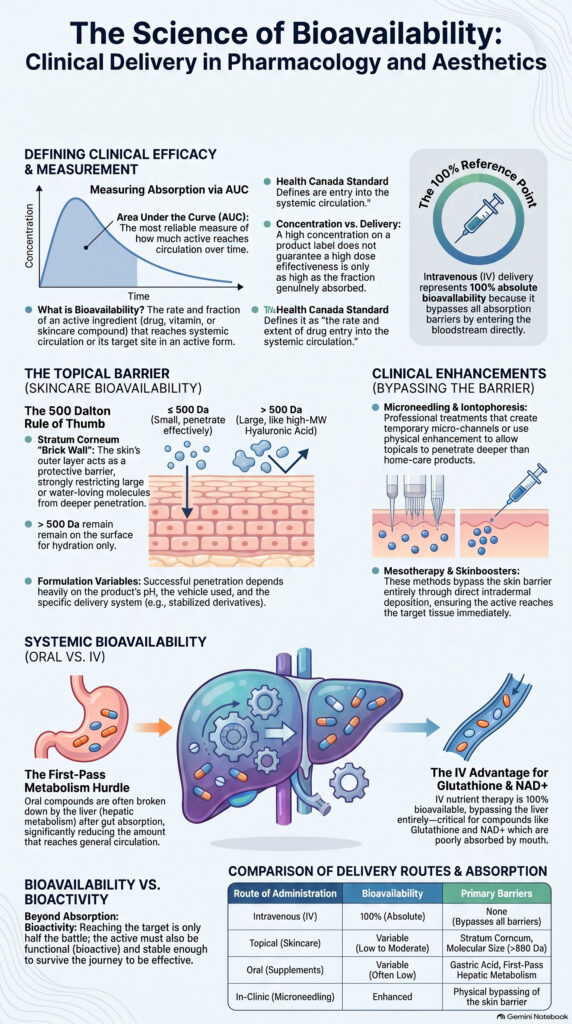
- Reference point: Intravenous (IV) delivery is defined as 100% bioavailable
- Key barriers: Incomplete absorption, first-pass metabolism (oral), and the skin barrier (topical)
- Skincare relevance: Determines whether a topical active penetrates rather than sitting on the surface
- Rule of thumb: On skin, molecules around 500 daltons or smaller penetrate most effectively
- Why it matters: A high concentration on the label does not guarantee a high dose reaching the target
What is bioavailability?
In pharmacology, bioavailability is defined as the rate and extent to which an active ingredient reaches the systemic circulation, or the site where it acts, in an active form.[1][3] Health Canada frames it in the same way—as “the rate and extent of drug entry into the systemic circulation.”[2] Expressed as a fraction from 0 to 100%, it captures a simple but important idea: the dose you apply or swallow is rarely the dose that actually arrives where it is needed.
How is bioavailability measured?
By convention, an intravenous dose—delivered straight into the bloodstream—is considered 100% bioavailable and serves as the reference standard against which other routes are compared.[1] Absolute bioavailability compares a route such as oral, topical or injected against IV, while relative bioavailability compares two non-IV products.[1] In practice it is calculated from the area under the concentration–time curve (AUC), the most reliable measure of how much active reaches the circulation over time.[3] Regulators depend on this: Health Canada uses comparative bioavailability to confirm that a generic drug behaves like the original before it is approved.[2]
What affects bioavailability?
Several factors determine how much of an active becomes available. The route of administration matters most—IV bypasses absorption entirely, while oral and topical routes face barriers.[1] For oral products, first-pass metabolism is central: after absorption from the gut, the liver breaks down part of the dose before it reaches the rest of the body, lowering the amount available.[1][3] Physicochemical properties—molecular size, solubility and lipophilicity—also shape absorption, as do the formulation, an individual’s physiology, and interactions with food or other substances.[3]
Why bioavailability matters in skincare
Skin is designed to keep things out. Its outer layer, the stratum corneum, behaves like a brick wall of cells set in a lipid matrix and strongly restricts water-loving and large molecules.[4] As a general rule, compounds around 500 daltons or smaller penetrate most effectively, while larger molecules tend to remain on the surface.[4] This is why formulation is so important: pH, the vehicle, stabilised derivatives and delivery systems can meaningfully change how much of an active—such as vitamin C or a peptide—actually gets in. It also explains why high-molecular-weight hyaluronic acid in a cream hydrates the surface rather than filling deeper tissue.
Bioavailability and in-clinic treatments
Many professional treatments are, in essence, ways of improving bioavailability by getting past the skin barrier. Microneedling creates temporary micro-channels that let topicals penetrate more deeply, and physical methods such as iontophoresis are used for the same purpose.[4] Mesotherapy and skinboosters go further, depositing actives directly into the skin so that far more of the dose reaches its target than a cream could deliver. In each case the aim is the same: raise the fraction of active that actually becomes available where it is needed.
Oral supplements versus IV and injectable delivery
The same principle applies inside the body. Many popular supplement ingredients have limited oral bioavailability, because absorption and first-pass metabolism reduce how much reaches the bloodstream.[1][3] This is part of the rationale behind IV nutrient therapy, in which nutrients are infused directly into a vein and are, by definition, fully bioavailable.[1] Ingredients often discussed in this context include glutathione and NAD+, both of which are absorbed poorly by mouth. Whether the intravenous route offers a meaningful advantage depends on the specific ingredient and the available evidence, so claims should be weighed carefully rather than assumed.
Bioavailability vs bioactivity: reading the claims
Bioavailability is not the whole story. An ingredient must also be bioactive—able to do something useful once it arrives—and stable enough to survive the journey. Marketing language such as “highly absorbable” or “clinically bioavailable” is common but not always substantiated, so it is worth looking for the concentration, the delivery system and, ideally, supporting evidence rather than the claim alone. Understanding bioavailability makes it easier to judge whether a product or treatment is genuinely likely to deliver on its promise.
Related glossary terms
- IV Nutrient Therapy
- Mesotherapy
- Microneedling
- Skinboosters
- Hyaluronic Acid
- Glutathione
- NAD+
Clinical & editorial sources
- Price G, Patel DA. Drug Bioavailability. StatPearls [Internet]. Treasure Island (FL): StatPearls Publishing; updated 2023 Jul 30. NBK557852
- Health Canada. Guidance Document: Conduct and Analysis of Comparative Bioavailability Studies. Government of Canada; revised 2023. canada.ca
- Le J. Drug Bioavailability. MSD Manual Professional Edition (Merck & Co.). msdmanuals.com
- Bakhrushina EO, Shumkova MM, Avdonina YV, et al. Transdermal Drug Delivery Systems: Methods for Enhancing Skin Permeability and Their Evaluation. Pharmaceutics. 2025;17(7):936. doi:10.3390/pharmaceutics17070936
This glossary entry provides general educational information and does not replace an individual clinical assessment or medical advice.
Clinically reviewed by: Leah Zawawi, RPN | Medical Aesthetics & Injectables.
Last reviewed: August 2026.