
Beta hydroxy acids (BHAs) are a group of oil-soluble exfoliating acids used in skincare and professional treatments. The main BHA used on the skin is salicylic acid. Because BHAs dissolve in oil, they can penetrate into sebum-filled pores—which makes them especially useful for oily, congested and acne-prone skin. Like alpha hydroxy acids they exfoliate, but they work more deeply inside the pore.
At a glance
- Type: Oil-soluble (lipophilic) chemical exfoliant (acid)
- Main BHA: Salicylic acid (2-hydroxybenzoic acid)
- Primary uses: Acne, blackheads and whiteheads, oily skin, congested pores, uneven texture
- How it differs from AHAs: Oil-soluble, so it works inside the pore (AHAs are water-soluble and work on the surface)
- Evidence: Well established for mild-to-moderate acne
- Canadian status: Salicylic acid is a permitted over-the-counter acne ingredient at 0.5–2% (Health Canada Acne Therapy monograph); higher strengths (20–30%) are professional peels
What are beta hydroxy acids?
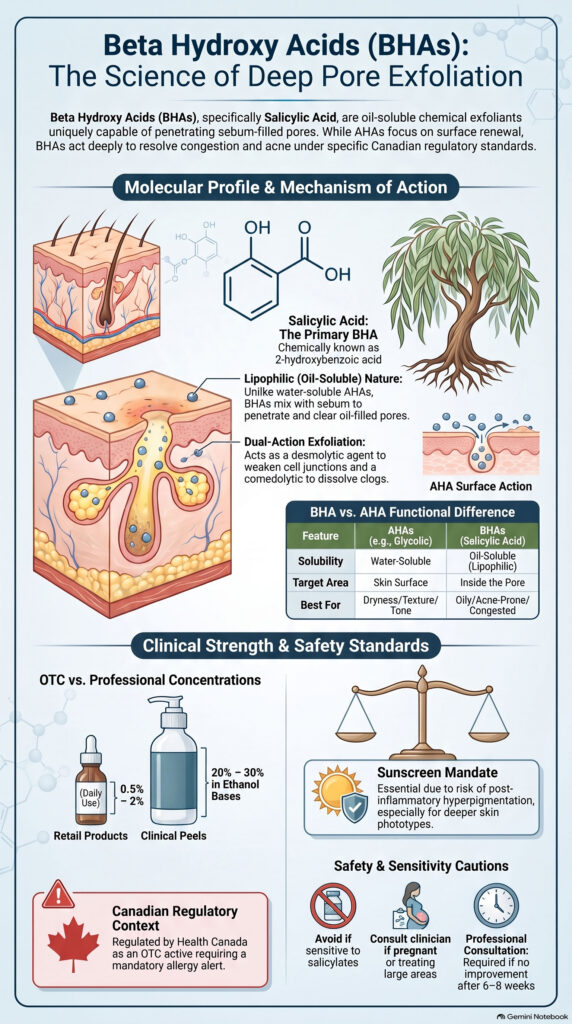
Beta hydroxy acids are organic acids in which the hydroxyl group sits two carbons away from the acid group—the “beta” position. In skincare, the BHA that matters is salicylic acid, historically derived from willow bark and closely related to aspirin. Unlike the water-soluble alpha hydroxy acids, salicylic acid is lipophilic (oil-soluble), so it mixes readily with the skin’s sebum and with the lipids that line hair follicles.[2][4] That single property—solubility in oil—explains most of what makes BHAs distinctive.
How do BHAs work?
Salicylic acid exfoliates by loosening the bonds that hold dead surface cells together, acting as a desmolytic agent that disrupts cell-to-cell junctions rather than breaking down keratin itself.[2] Because it is oil-soluble, it travels into the pore and helps clear the mix of dead cells and sebum that leads to clogging—a comedolytic effect that makes it valuable for acne.[2] It also has anti-inflammatory properties, most pronounced at concentrations between 0.5–5%.[2] In acne specifically, salicylic acid slows the shedding of cells inside the follicle so they are less likely to block the pore.[3]
What’s the difference between BHAs and AHAs?
The key distinction is solubility. AHAs such as glycolic acid are water-soluble and work mainly on the skin’s surface, which suits dryness, rough texture and uneven tone. BHAs are oil-soluble and can penetrate oil-filled pores, so they are often chosen for oily, congested or acne-prone skin.[4] Neither is simply “better”—they solve different problems, and many regimens combine the two, using an AHA for surface renewal and a BHA for the pores.
How are BHAs used in skincare and medical aesthetics?
BHAs are used across a range of strengths. In daily-use cleansers, toners and serums, salicylic acid typically appears at 0.5–2% for ongoing exfoliation and acne control.[1] In professional chemical peels it is used at higher concentrations—commonly 20–30% in an ethanol base—to resurface the skin and target acne, oiliness and related concerns.[2] A practitioner selects the concentration, vehicle and contact time to suit the skin concern and skin type.
What does the evidence say?
Salicylic acid is well established for mild-to-moderate acne, including blackheads and whiteheads, and is widely valued for oily and congested skin.[1][2] As a peeling agent it has also been described as beneficial for texture and for conditions such as melasma and photodamage.[2] Because it targets the pore, it is often preferred over AHAs for acne-prone skin, while AHAs remain a first choice for surface dryness and uneven tone. As with most exfoliating acids, results build with consistent use rather than appearing overnight, and outcomes depend on concentration, formulation and how the product is used.
Is it safe? Side effects and cautions
Mild dryness, stinging or peeling are common—especially at higher strengths—and usually settle with less frequent use or a lower concentration. Health Canada requires over-the-counter acne products containing salicylic acid to carry an allergy alert, advising people to get medical help right away for signs of a serious allergic reaction such as hives, swelling of the eyes or mouth, blistering or difficulty breathing.[1] People with salicylate sensitivity should avoid it, and use over large areas or at high concentration—particularly during pregnancy—should be discussed with a clinician. In deeper Fitzpatrick skin phototypes, higher-strength peels also carry more risk of post-inflammatory hyperpigmentation, so sensible sun protection is worthwhile while exfoliating.
Regulatory context in Canada
In Canada, salicylic acid is a permitted over-the-counter acne ingredient at 0.5–2% under Health Canada’s Acne Therapy monograph, which sets out the approved claims (“helps treat acne pimples”), directions and warnings for these products.[1] Higher-concentration formulations used for professional peeling—commonly 20–30%—fall outside consumer OTC acne products and are applied in a clinical setting.[2] Health Canada also advises stopping and consulting a health professional if acne does not improve within 6–8 weeks of consistent use.[1]
Related glossary terms
- Alpha Hydroxy Acids
- Salicylic Acid
- Glycolic Acid
- Chemical Peel
- Trichloroacetic Acid
- Post-Inflammatory Hyperpigmentation
- Fitzpatrick Skin Phototype
Clinical & editorial sources
- Health Canada. Acne Therapy Monograph. Natural and Non-prescription Health Products Directorate, Health Products and Food Branch. hc-sc.gc.ca
- Arif T. Salicylic acid as a peeling agent: a comprehensive review. Clin Cosmet Investig Dermatol. 2015;8:455–461. doi:10.2147/CCID.S84765
- DermNet. Salicylic acid. DermNet (New Zealand). dermnetnz.org
- Kornhauser A, Coelho SG, Hearing VJ. Applications of hydroxy acids: classification, mechanisms, and photoactivity. Clin Cosmet Investig Dermatol. 2010;3:135–142. PMC3047947
This glossary entry provides general educational information and does not replace an individual clinical assessment or medical advice.
Clinically reviewed by: Leah Zawawi, RPN | Medical Aesthetics & Injectables.
Last reviewed: August 2026.