
Androgenetic alopecia (AGA), commonly called male-pattern or female-pattern hair loss, is the most common cause of progressive hair thinning. It is a genetically influenced, androgen-driven condition in which sensitive hair follicles gradually shrink, producing finer, shorter hairs and a recognizable pattern of loss across the scalp. It is not a sign of poor general health, and several evidence-based treatments can slow it or partially restore density.
At a glance
- Also called: Male-pattern and female-pattern hair loss
- Cause: Inherited sensitivity to androgens (chiefly DHT), leading to follicle miniaturisation
- Pattern: Men — temples and crown (Norwood–Hamilton scale); women — diffuse thinning over the crown with a widening part, frontal hairline usually preserved (Ludwig scale)
- Prevalence: Around 50% of men by age 50 (up to ~80% by 70); rises in women after menopause
- Evidence-based options: Topical minoxidil, oral finasteride or dutasteride, PRP, microneedling, low-level laser therapy
- Canadian status: Topical minoxidil is available over the counter; finasteride and dutasteride are prescription-only
What is androgenetic alopecia?
Androgenetic alopecia is a genetically predetermined disorder caused by an excessive follicular response to androgens—male-type hormones that are present in both sexes.[1] It affects roughly half of men and women over a lifetime. In men it can begin any time after puberty; in women it often becomes noticeable later, with incidence rising after menopause.[1][4] Because the process is gradual and patterned rather than patchy or sudden, it is usually distinguished from other causes of shedding such as telogen effluvium.
What causes androgenetic alopecia?
Two factors combine: genetic predisposition and androgens. In affected follicles, researchers consistently find elevated levels of dihydrotestosterone (DHT), increased activity of the enzyme 5-alpha-reductase (mainly the type 2 isoform), and a greater number of androgen receptors.[1] DHT is converted from testosterone by 5-alpha-reductase and binds to receptors in genetically susceptible follicles, setting off the changes that lead to visible thinning. This is why the condition tends to run in families and why lowering DHT is a central treatment strategy.
How androgenetic alopecia affects the hair follicle
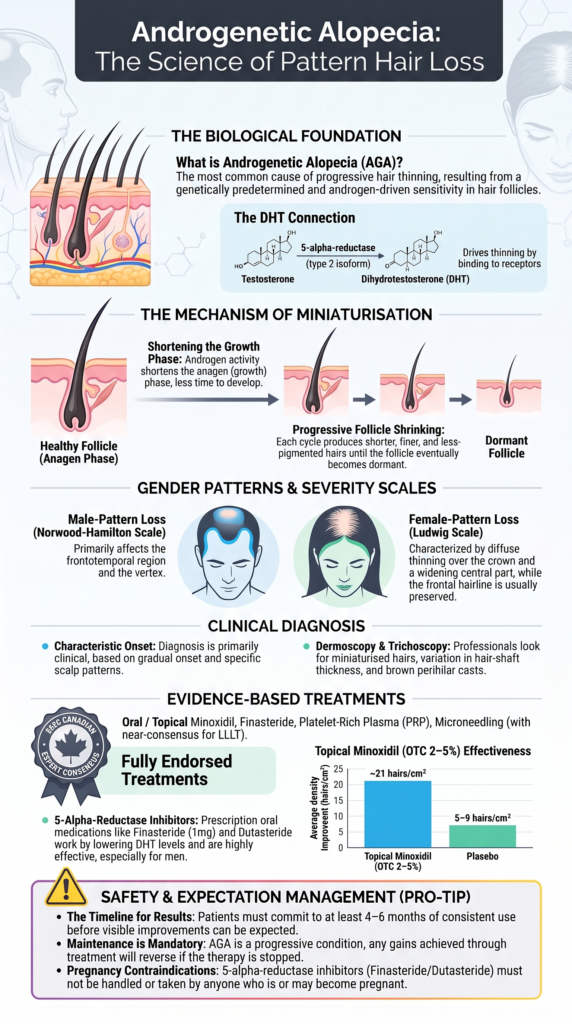
Each hair moves through a repeating hair-growth cycle of growth (anagen), transition and rest. In AGA, androgen activity shortens the anagen phase and drives progressive miniaturisation of the follicle.[1] With each cycle the follicle produces a shorter, finer, less-pigmented hair until, over years, it may stop producing visible hair altogether. Because dormant follicles are harder to revive, starting treatment earlier—while follicles are still active—generally gives the best results.
Male-pattern vs female-pattern hair loss
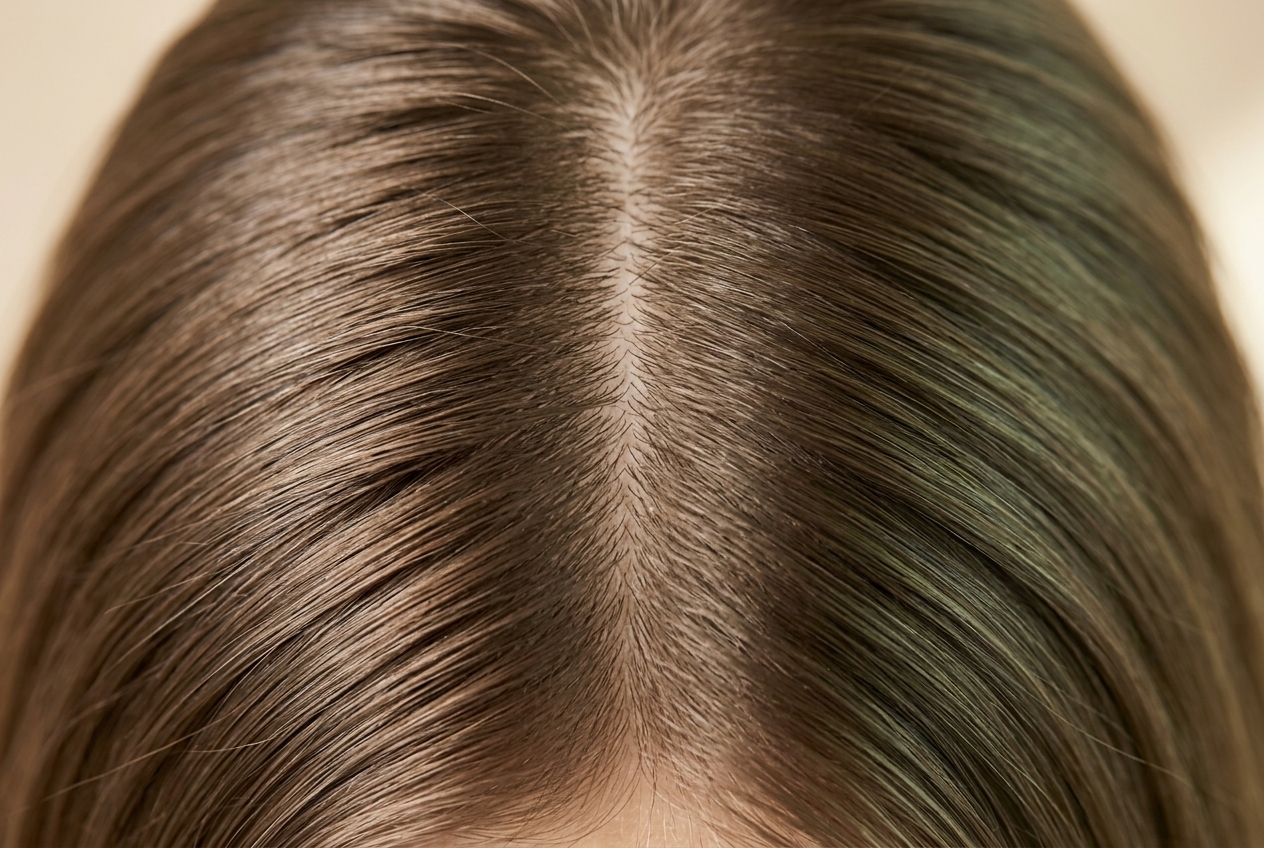
The pattern differs by sex. In men, loss is most prominent at the frontotemporal region (the temples) and the vertex (crown), and clinicians grade its severity with the Norwood–Hamilton scale.[1] In women, the frontal hairline is usually preserved while thinning spreads diffusely over the crown and widens the central part; this is graded with the Ludwig scale.[1] Recognising the pattern is a key part of diagnosis, because it separates AGA from more diffuse or patchy forms of hair loss.
How is androgenetic alopecia diagnosed?
Diagnosis is usually clinical, based on the gradual onset, the characteristic pattern and often a family history.[1] Dermoscopy (also called trichoscopy) supports the diagnosis by revealing miniaturised hairs, variation in hair-shaft thickness and brown perihilar casts around the follicle openings. A scalp biopsy is rarely required and is reserved for cases where the diagnosis remains unclear or another condition is suspected.[1]
How is androgenetic alopecia treated?
Several treatments have good evidence, and they work best when started early and continued long term. Topical minoxidil—the mainstay of therapy and available over the counter in Canada at 2–5%—is a vasodilator that prolongs the growth phase; trials show it improves hair density by about 21 hairs/cm² compared with 5–9 for placebo over 16–48 weeks.[2] Oral 5-alpha-reductase inhibitors—finasteride (1 mg daily) and dutasteride—lower DHT and are prescription medicines; in men, finasteride is generally more effective than topical minoxidil.[1][2] A 2025 Canadian expert consensus gave full endorsement to oral finasteride and dutasteride, topical and oral minoxidil, topical finasteride, platelet-rich plasma (PRP) and microneedling, with near-consensus support for low-level laser therapy.[3] Results take time: expect at least 4–6 months of consistent use before improvement is visible, and gains reverse if treatment stops.[1]
Regulatory & safety context in Canada
In Canada, topical minoxidil is a non-prescription (over-the-counter) product, while oral finasteride and dutasteride require a prescription and medical supervision.[2][3] These medicines carry important cautions—for example, finasteride and dutasteride should not be handled or taken by anyone who is or may become pregnant, and some people report sexual side effects—so the choice of treatment should be individualised with a qualified clinician.[3][4] Because hair loss can occasionally signal another underlying condition, a proper assessment is worthwhile before starting any therapy.
Infographic of Androgenetic Alopecia
Related glossary terms
- Dihydrotestosterone (DHT)
- Hair Growth Cycle
- Miniaturization
- Telogen Effluvium
- PRP Hair Restoration
- Microneedling
- Low-Level Laser Therapy
Clinical & editorial sources
- Ho CH, Sood T, Zito PM. Androgenetic Alopecia. StatPearls [Internet]. Treasure Island (FL): StatPearls Publishing; updated 2024 Jan 7. NBK430924
- Braschi É, Kiciak A, Young J. Topical minoxidil for androgenetic alopecia. Canadian Family Physician. 2025;71(7–8):499. cfp.ca
- Landells I, Chow E, Gupta AK, et al. A Canadian Consensus on Androgenetic Alopecia: Approach and Management. J Cutan Med Surg. 2025;29(5_suppl). doi:10.1177/12034754251368849
- Zargham H. Management of Androgenetic Alopecia in Men in 2025: A Focused Review. Canadian Dermatology Today. 2025;6(1):31–36. canadiandermatologytoday.com
This glossary entry provides general educational information and does not replace an individual clinical assessment or medical advice.
Clinically reviewed by: Leah Zawawi, RPN | Medical Aesthetics & Injectables.
Last reviewed: August 2026.