
Alpha hydroxy acids (AHAs) are a group of naturally derived, water-soluble acids used in skincare and professional treatments to exfoliate the skin’s surface. By loosening the bonds between dead surface cells, AHAs help reveal smoother, brighter, more even-toned skin, and they are a cornerstone ingredient in many chemical peels.
At a glance
- Type: Water-soluble chemical exfoliant (acid)
- Common acids: Glycolic, lactic, mandelic, citric, malic, tartaric
- Primary uses: Exfoliation, photoaging, uneven tone, rough texture, mild acne
- Evidence: Moderate; strongest for glycolic and lactic acid
- Canadian status: Permitted in consumer cosmetics up to 10% (pH 3.5 or higher); higher strengths are professional-use (Health Canada Hotlist)
What are alpha hydroxy acids?
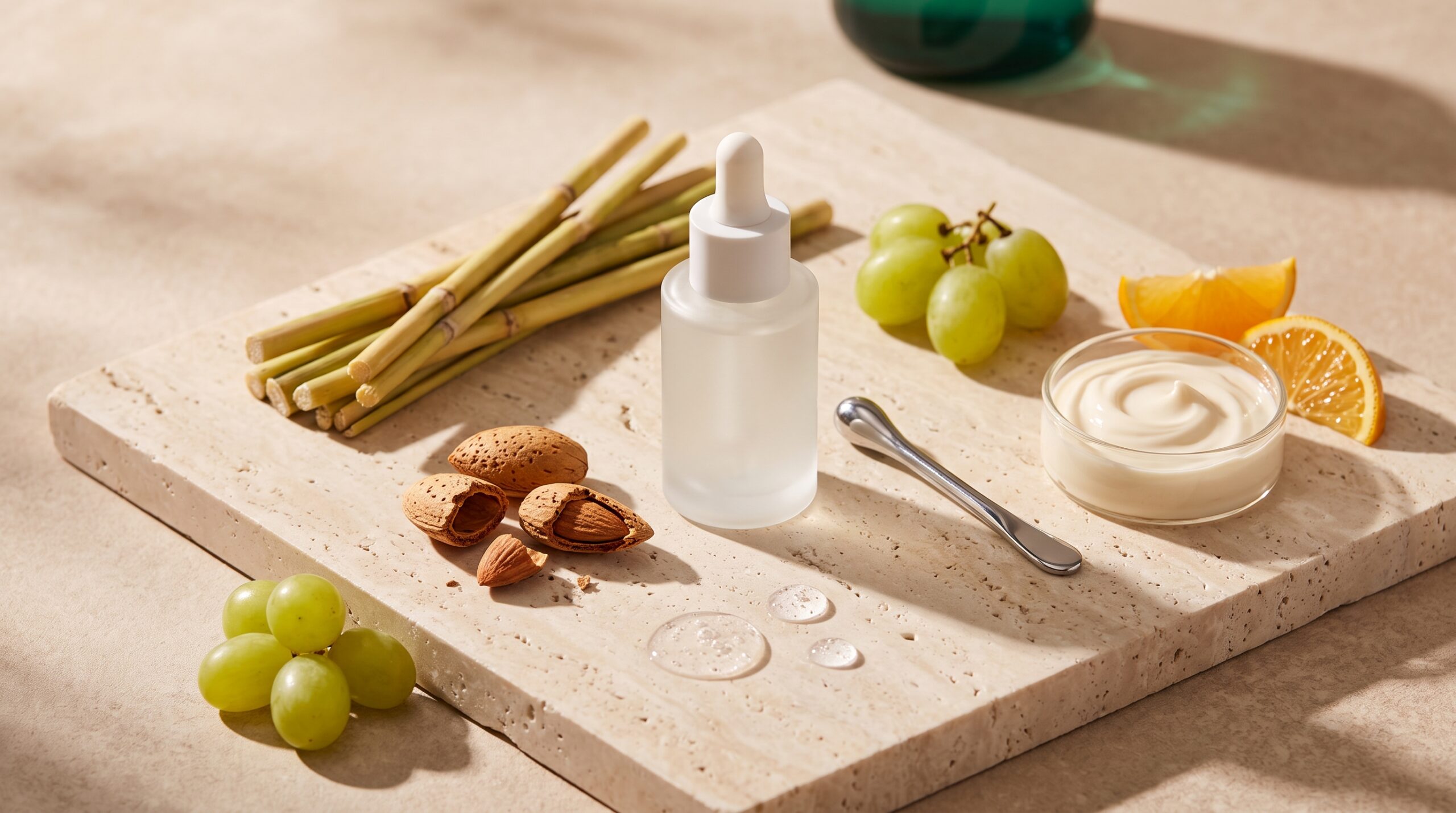
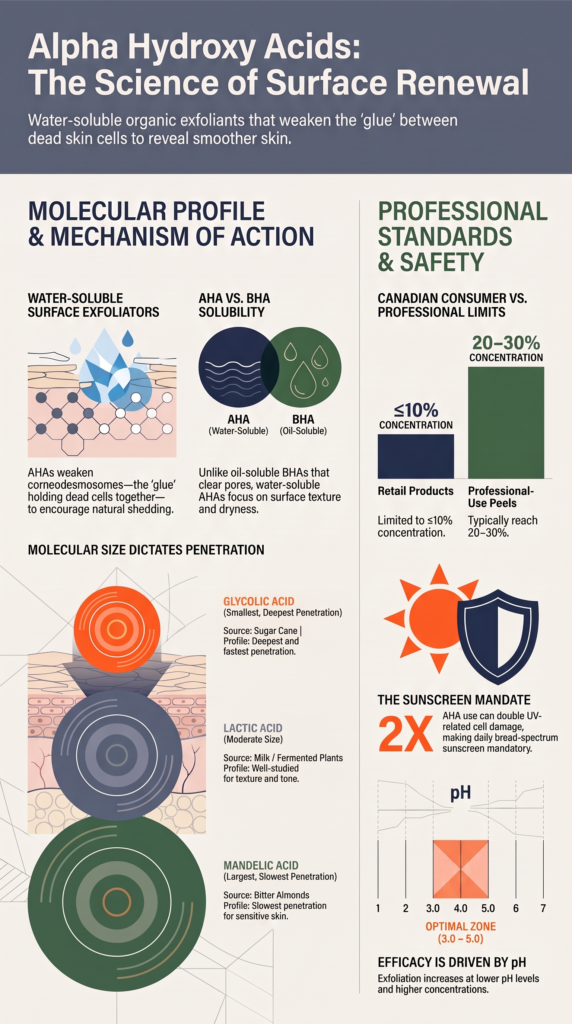
AHAs are a family of organic acids that carry a hydroxyl group on the carbon next to the acid group. Most are derived from natural sources: glycolic acid from sugar cane, lactic acid from milk and fermented plants, mandelic acid from bitter almonds, citric acid from citrus fruit, malic acid from apples, and tartaric acid from grapes. Because they are water-soluble, AHAs act mainly at the skin’s surface. Glycolic acid has the smallest molecular size and penetrates most readily, while larger molecules such as mandelic acid penetrate more slowly and tend to be gentler.[3][4]
How do AHAs work?
AHAs exfoliate by weakening the “glue” that holds dead surface cells (corneocytes) together, encouraging the breakdown of corneodesmosomes so those cells shed more easily. The result is a smoother surface and more even tone. Beyond exfoliation, research suggests AHAs can stimulate fibroblast activity and collagen synthesis and support the skin’s lipid barrier, which may reduce water loss over time.[3][4] Their activity depends heavily on formulation: a lower pH (typically 3–5) and higher concentration increase both exfoliation and penetration.[4]
How are AHAs used in medical aesthetics?
AHAs are used across a range of strengths. In daily-use serums and creams they typically appear at 5–10% for gentle, ongoing exfoliation. In professional chemical peels they are used at higher concentrations (commonly 20–30%) to resurface the skin more noticeably. A practitioner selects the acid, concentration, pH, and contact time to suit the skin concern and skin type.[4]
What’s the difference between AHAs and BHAs?
The key distinction is solubility. AHAs are water-soluble and work mainly on the surface, which suits dryness, rough texture, and uneven tone. Beta hydroxy acids (BHAs) such as salicylic acid are oil-soluble and can penetrate oil-filled pores, so they are often chosen for oily or acne-prone skin. Many regimens combine the two.
What does the evidence say?
The best-studied AHAs are glycolic and lactic acid. Clinical studies report improvements in fine lines, texture, and pigmentation with topical AHAs and AHA peels, and glycolic acid has been shown to increase collagen in the skin.[4] For pigmentation, AHAs may help fade post-inflammatory hyperpigmentation and other discoloration, though results vary.[4] Evidence for acne is more limited but suggests AHAs—particularly combined with salicylic acid—can reduce lesions.[4] Outcomes depend on concentration, pH, formulation, and use, and reviewers note the optimal parameters are still not fully defined.[4]
Are AHAs safe? Side effects and sun sensitivity
Mild, temporary redness, stinging, or dryness are common and usually settle with continued use or a lower concentration. The most important safety point is photosensitivity: AHAs increase the skin’s sensitivity to UV light. The U.S. FDA cites research in which UV-induced redness sensitivity rose about 18% and UV-related cell damage roughly doubled after four weeks of AHA use—an effect that reversed within about a week of stopping.[2] Daily broad-spectrum sunscreen is therefore essential when using AHAs. Higher-strength peels also carry more risk of irritation and, in deeper Fitzpatrick skin phototypes, post-inflammatory hyperpigmentation.
Regulatory context in Canada
Under Health Canada’s Cosmetic Ingredient Hotlist, AHAs in consumer cosmetics are limited to 10% or less at a pH of 3.5 or higher, and products above 3% AHA must carry a warning statement. Higher-concentration, professional-use products (generally 10–30% at pH 3–3.5) fall outside consumer limits, and formulations above 30% or below pH 3.0 are regulated as drugs rather than cosmetics.[1] U.S. FDA labeling guidance similarly recommends a “Sunburn Alert” advising sunscreen use during and for a week after use.[2]
Infographic on Alpha Hydroxy Acids
Related glossary terms
- Beta Hydroxy Acids
- Chemical Peel
- Trichloroacetic Acid
- Enzyme Exfoliator
- Post-Inflammatory Hyperpigmentation
- Fitzpatrick Skin Phototype
- Neocollagenesis
Clinical & editorial sources
- Health Canada. Cosmetic Ingredient Hotlist: Prohibited and Restricted Ingredients. Government of Canada. canada.ca
- U.S. Food & Drug Administration. Alpha Hydroxy Acids (Cosmetic Ingredients). fda.gov
- Kornhauser A, Coelho SG, Hearing VJ. Applications of hydroxy acids: classification, mechanisms, and photoactivity. Clin Cosmet Investig Dermatol. 2010;3:135–142. PMC3047947
- Karwal K, Mukovozov I. Topical AHA in Dermatology: Formulations, Mechanisms of Action, Efficacy, and Future Perspectives. Cosmetics. 2023;10(5):131. doi:10.3390/cosmetics10050131
This glossary entry provides general educational information and does not replace an individual clinical assessment or medical advice.
Clinically reviewed by: Leah Zawawi, RPN | Medical Aesthetics & Injectables.
Last reviewed: August 2026.