
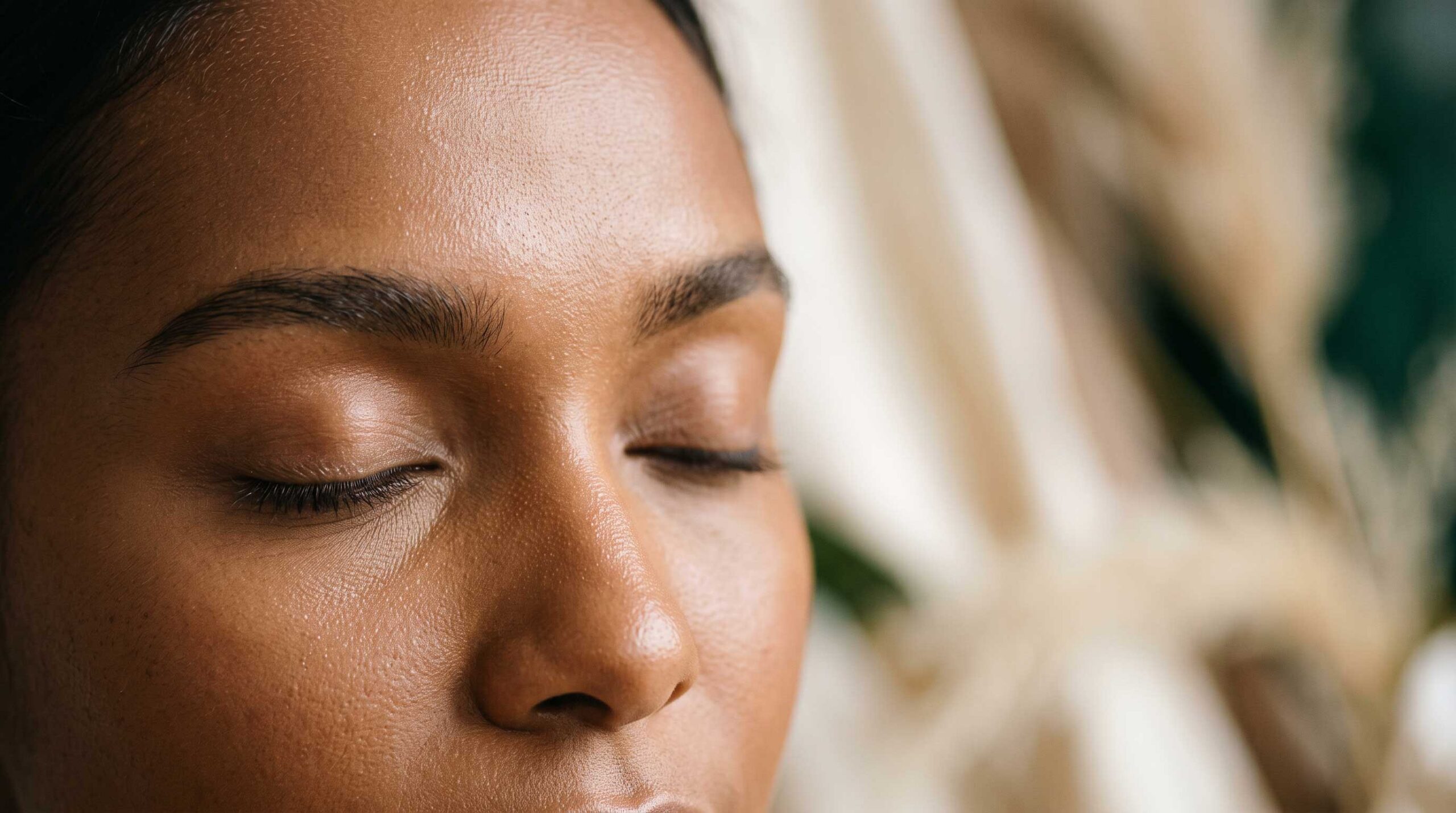
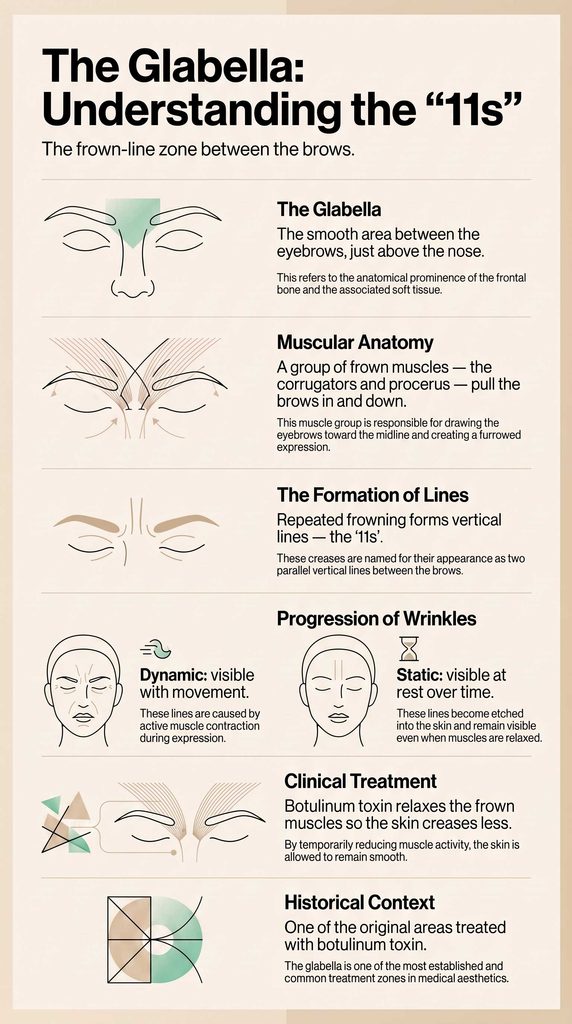
The glabella is the smooth area of the forehead between the eyebrows, just above the nose. It is best known in aesthetics as the home of frown lines—the vertical creases (often called “the 11s”) that appear between the brows when you frown or concentrate. Because these lines are created by a small group of muscles, the glabella is one of the most common areas treated with botulinum toxin.
At a glance
- What it is: The smooth area of bone and skin between the eyebrows, above the nose
- Also a landmark: A recognised anatomical reference point on the skull
- The muscles: A group of “frown” muscles—the corrugators, procerus and others—pull the brows in and down
- Glabellar lines: The vertical frown lines between the brows, commonly called “the 11s”
- Classic treatment area: One of the first and most common areas treated with botulinum toxin
- Line type: Start as dynamic (with movement) and can become static (visible at rest) over time
What is the glabella?
Anatomically, the glabella is the smooth prominence of the frontal bone that sits between the two brow ridges, just above the bridge of the nose.[1] In everyday aesthetic use, the term also refers to the soft-tissue area—the skin and muscle—in that same central spot between the eyebrows. The glabella is a well-recognised landmark in anatomy and is used as a reference point on the skull.[1] For most people, though, its significance is cosmetic: it is the exact place where frown lines form.
The muscles behind the frown
The lines at the glabella are produced by a coordinated group of small muscles sometimes called the glabellar complex—chiefly the paired corrugator supercilii, the procerus, and the depressor supercilii, with contributions from the surrounding orbicularis oculi.[1] These are the “medial brow depressors”: they draw the eyebrows inward and downward. The corrugator muscles pull the brow toward the midline to create the vertical frown lines, while the procerus pulls down at the top of the nose to create a horizontal crease at the root of the nose.[1] Together they produce the frowning, furrowed expression.
Glabellar lines: the “11s”
Glabellar lines are the vertical creases between the eyebrows, so named “the 11s” because two parallel lines can look like the number eleven. They are a classic example of dynamic wrinkles—lines caused by repeated muscle movement rather than by the skin alone.[1] Every time the frown muscles contract, they fold the skin above them; over years of expression, those folds begin to show. Early on the lines appear only with movement, but with time and loss of skin support they can become static wrinkles that remain visible even when the face is relaxed.
How glabellar lines are treated
Because they are driven by muscle action, glabellar frown lines respond well to botulinum toxin type A, which temporarily relaxes the frown muscles so they crease the skin less.[1][2] In fact, the glabella is one of the original and most established areas for cosmetic botulinum toxin.[1] Products such as Botox and Dysport are commonly used here, often alongside treatment of nearby areas like crow’s feet and forehead lines. At Revel, this is offered through our neuromodulator treatments. Results typically build over about two weeks and last several months.
When lines become set
Once a glabellar line is etched at rest, relaxing the muscle alone may soften it but not fully erase it. At that stage the skin itself needs support, and a small amount of dermal filler may be used with care to smooth a deep static crease—though the glabella is an area where injectors are especially cautious, because it is considered higher-risk for filler complications. Often the most natural result comes from relaxing the muscle for the dynamic component and supporting the skin for the static one, planned by an experienced injector. This entry is educational and does not replace an individual clinical assessment.
Related glossary terms
- Dynamic Wrinkles
- Static Wrinkles
- Botulinum Toxin Type A
- Botox
- Dysport
- Crow’s Feet
- Revel: Neuromodulator Treatments
Clinical & editorial sources
- Chaurasia A, Sharma A. Anatomy, Head and Neck: Glabella. StatPearls [Internet]. Treasure Island (FL): StatPearls Publishing; updated 2023 Jul 24. NBK555993
- Padda IS, Tadi P. Botulinum Toxin. StatPearls [Internet]. Treasure Island (FL): StatPearls Publishing; updated 2023 Nov 6. NBK557387
This glossary entry provides general educational information and does not replace an individual clinical assessment or medical advice.
Clinically reviewed by: Leah Zawawi, RPN | Medical Aesthetics & Injectables.
Last reviewed: August 2026.